
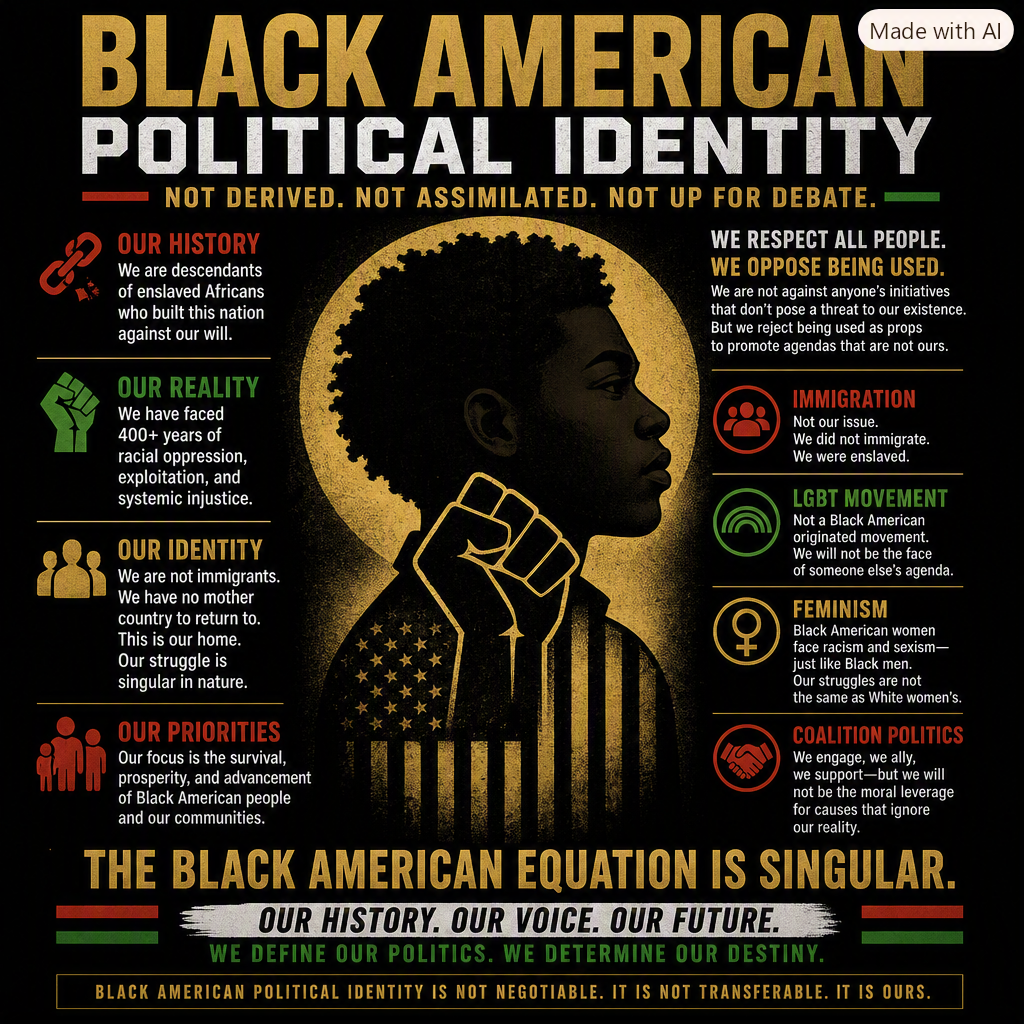

Black Americans have a singular historical experience in the United States — and because of that, many national political agendas simply don’t map onto our reality. The problem isn’t the existence of those agendas; it’s the way certain political coalitions use Black visibility to advance them.
Why Black Americans resist being “the face” of others’ movements. The argument isn’t about hostility toward immigrants, LGBT people, feminists, or any other group. It’s about instrumentalization — being used symbolically.
Here’s the dynamic:
Coalition politics in the U.S. often rely on moral narratives.
Black Americans — because of our history — carry enormous moral weight.
Political actors know this.
So they attach Black faces, Black slogans, Black imagery, and Black suffering to causes that didn’t come from Black communities.
This creates a distortion:
Black Americans become the “front line” for agendas that don’t address Black American survival, prosperity, or autonomy.
Black American political needs cannot be substituted, merged, or absorbed into other groups’ agendas.
Black Americans don’t oppose others’ causes.
Black Americans oppose being used as symbolic leverage for causes that aren’t ours.
Liberal coalitions often attach Black faces to agendas that don’t address Black American survival or prosperity.
This erases the singular nature of Black American history and political needs.